The title is hopeful. I have been riddled with self-doubt. Even getting this sentence out takes an enormous amount of willpower. I am claiming the power to disbelieve everything, except that I can.
My aim is to learn from myself how I am unlearning myself. Maybe one day it will help you too. If I finish this article, we will both be one step closer.
I've been trying to start a successful business — and that has been exactly it, trying. A few steps forward, then nothing. I would finish something to a point, then stop. Then I would forget. I would do something else completely. Then I'd repeat the pattern. Let's just say I had great ideas, but a hard time finishing anything for myself, and wanted to die of shame at the thought of it being seen in public. Worst of all, it had not always been like this, and I had no explanation other than having relocated five years ago.
Completing tasks for others was easy in comparison, whether out of love or fear. So why was it so hard to do anything for myself and stick to it? Did my mother control me so much through guilt that I never learnt to set self-directed tasks? Was I going through dopamine withdrawal, my brain rearranged by years of living inside a phone? Maybe the real answer was simpler. The Viennese psychologist Alfred Adler wrote that our ability to measure our own value is entirely dependent on our community and our feeling for it — that contribution is the one thing that can lead a human being to happiness. And I had lost all sense of community: isolating myself long past the lockdowns, spending most of my time inside my phone and my head. Something had to change.
The questionnaire that named me
Then, some weeks back, I filled out a business-coaching questionnaire. I had come to coaching because I was at my wit's end. I couldn't keep trying out life. I wanted my own business, and I finally wanted it to work. The form was meant to tell me what motivated my actions. "Inner Drivers — Self-Assessment." It turned out I am driven by "It has to be perfect" and "I have to please everyone." These were my greatest motivators and my biggest stumbling blocks. I was not surprised. But how should I apply that?
I knew I could produce top-quality work, and that I thrived on empathy and clear communication. What surprised me was that this also made me a perfectionist and a people pleaser. It took some time to sink in. What drove me to success also drove me to failure.
If I were my own best friend, rather than my own ego, what would I say? I might explain that perfectionism is a control-freak's attempt to make now into "then" — except "then" is always imaginary, and therefore incomplete. The perfectionist's goalpost keeps shifting and cannot be reached, because she can never be satisfied in the moment.
What drove me to success also drove me to failure.
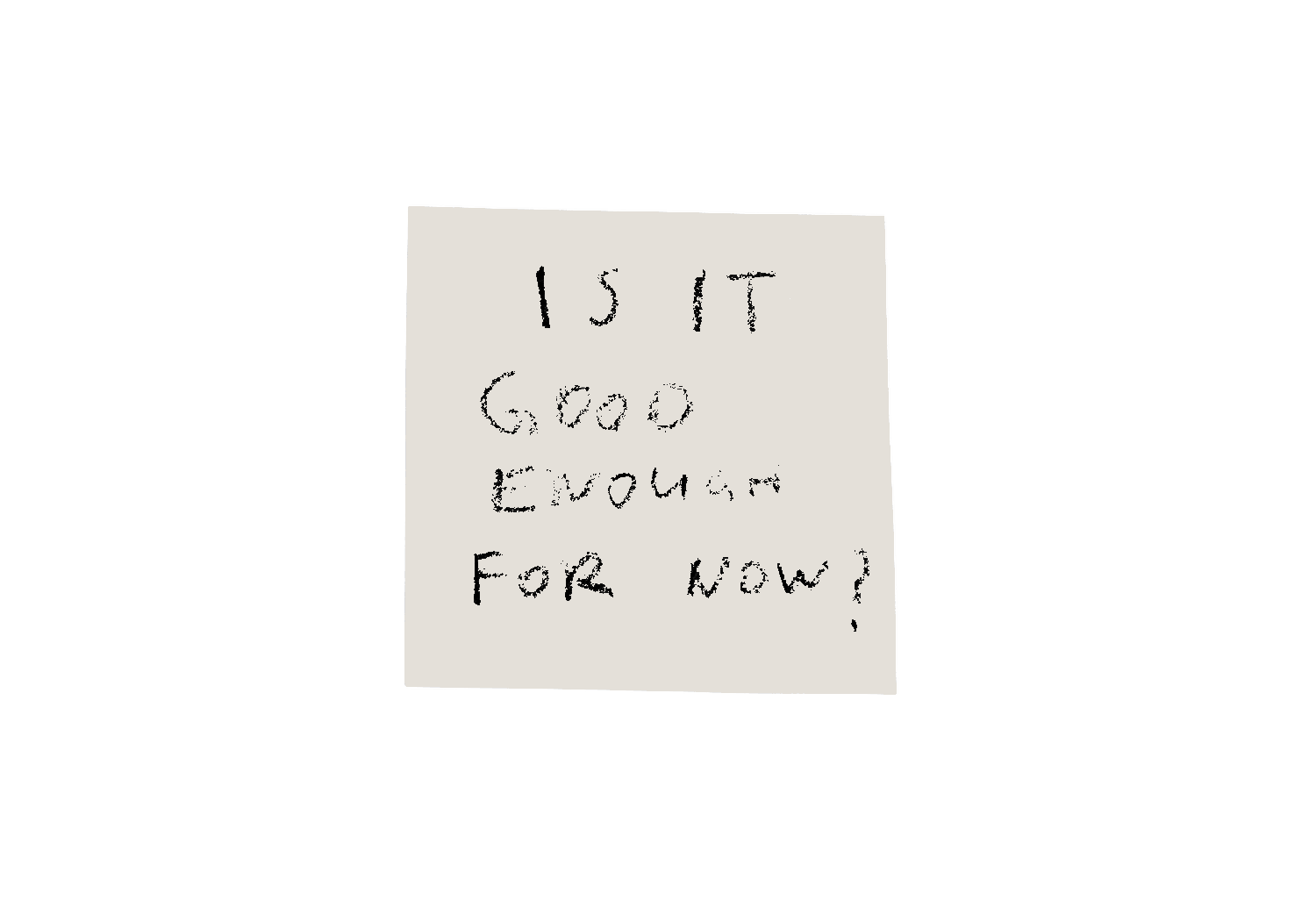
I looked at the enormous list of unfinished tasks and projects — the paperwork on the desk, the files on the computer — and wondered why I had abandoned them. It seemed nobody cared, nobody was listening, my contribution was meaningless anyway. Against that, I resolved to ask one question of the work: "Is it good enough for now?" The goal was effective action, rather than drowning in avoidance, fear and procrastination.
As for people-pleasing, I came to see it as a quiet form of manipulation, resorted to by a coward — because you can only please everyone if you conceal a part of yourself, and so never commit to revealing who you actually are in public. At first I thought it might help to ask, "Does it please some of the people, some of the time?" In the end, I realised I had to ask, "Does it please me?"
By the end of that reflection I was still tapping in the dark, but I had two questions to guide me. Over the next week, I started writing this. I translated some old offers and wrote new ones. I managed to persist, and to share them. Yes, I made mistakes, and yes, they were imperfect. They were fine, though — works in progress. "Is it good enough for now?" Sometimes. "Does it please me?" Often enough to feel good about it. Let's keep going.
Fear and anxiety, in the body
In the overwhelm of ordinary days, the way these beliefs had shaped and constricted my life slowly came into focus. I could see some of my patterns more clearly — how I avoided doing things because of what someone might think of the outcome, or, put plainly, out of grave doubt. Still, much of what I was living with stayed hidden from me.
One day in Honest Sharing — a practice of self-disidentification I now do daily with a partner — I began to notice myself over-interpreting: anxiously making mental notes about the world, trying to read a body through a face, fearing I could do something wrong before I had even voiced a thought, scanning for any hint of a reaction in case I was guilty, or in danger. I felt my inner thighs tense, getting ready to defend my stomach in case an attack was imminent. I felt my mind hunt for reasons I might be hurtful, upsetting or offensive. It was the first time in my life I was able to notice this, and to describe what was happening in me to another human being. Before that, I hardly knew it was there.
That is where I am — not understanding it yet, but beginning to overcome it. The questions are simple, and I have to keep asking them. Is it good enough for now? Does it please me? The page is where I find out.
See you on the page.