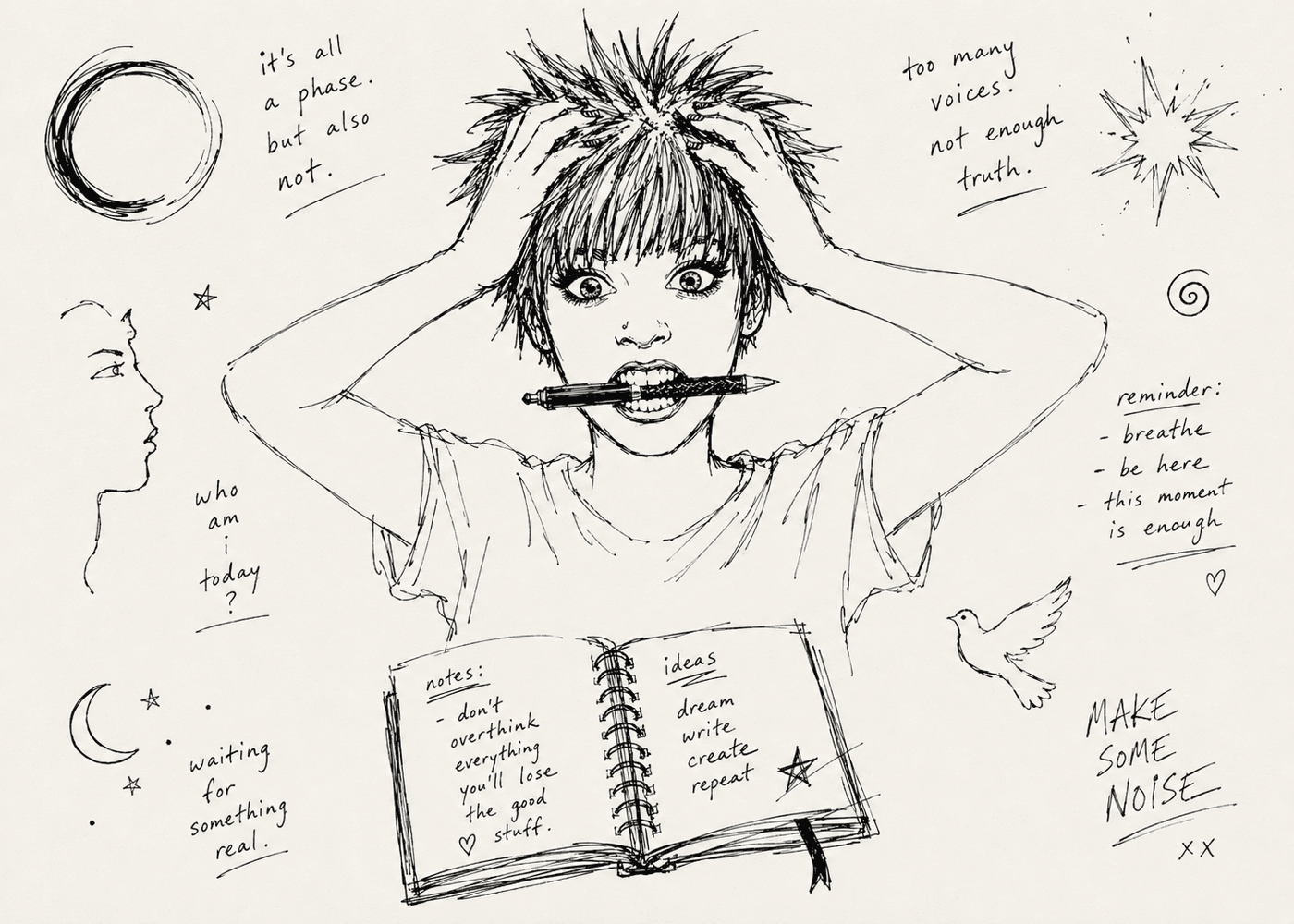
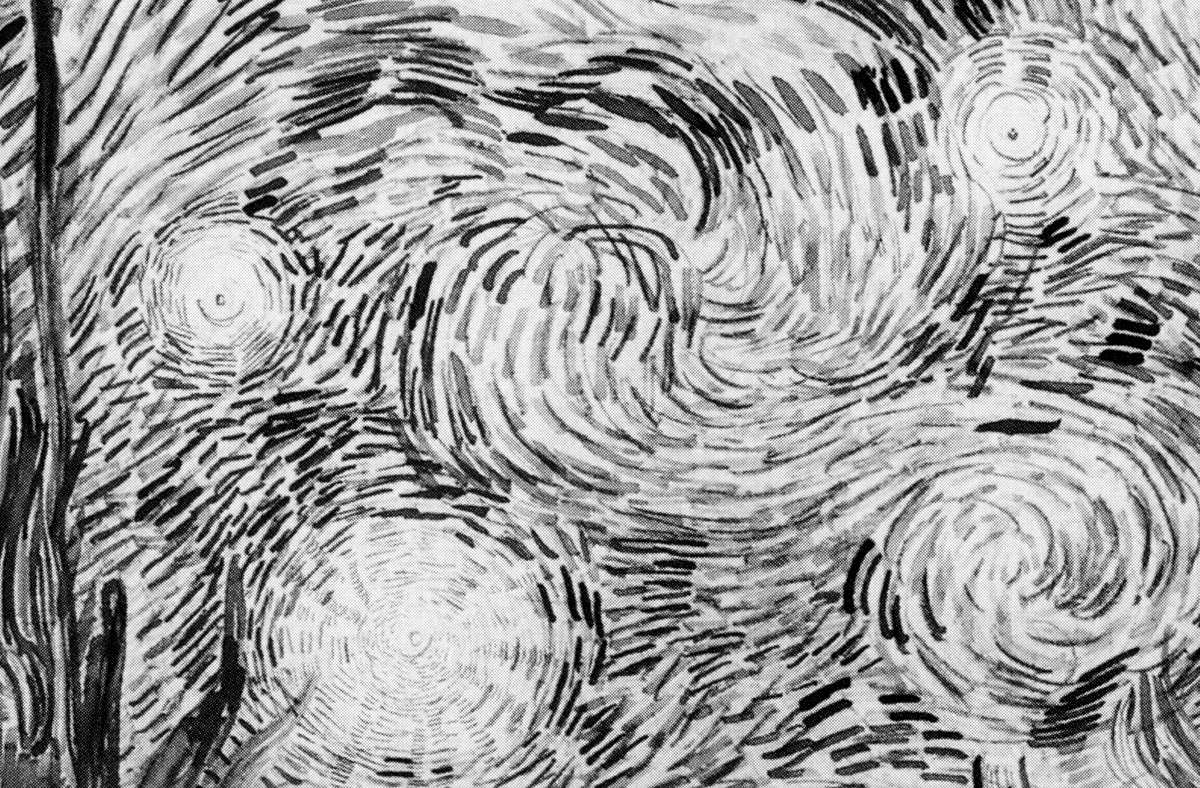
My difficult friend was on the phone, deep in an hour of complaint. I knew why she was hurting. I felt for her, and it cost me something to keep listening. Somewhere in there my pen started moving on its own: a spiral, a row of loops down the margin, a shape that kept growing. I have done it for years, in hard calls and the backs of notebooks. Most of us have. We call it doodling, and half-believe we ought to stop.
That instinct to fill the margin is not idleness. The hand reaches for the page because the marks are doing something for us — and once you know what, you can do it on purpose.
More than passing time
A much-cited experiment by the cognitive psychologist Jackie Andrade put it to the test. She gave people a long, dull phone message to keep track of; half were asked to shade in shapes while they listened. The doodlers remembered almost a third more of what they’d heard. The marks had not pulled them away from the call — they had kept them in the room for it.
Stress responds in the same direction. At Drexel University in Philadelphia, art therapists measured cortisol — the body’s main stress hormone — in people before and after they spent three quarters of an hour making something by hand. The levels dropped, and they dropped whether or not the person could draw a thing. The ease was not in the result. It was in the making.
When the music leads
You can feel why, if you watch your own hand. A doodle is repetition with small differences — the same loop again, never quite the same. The movement finds a rhythm, and the racing in your chest slows to meet it. Not because anything has been solved, but because the body has been given something steady to do while the mind catches up. It is the plainest version of what gets called mindful doodling, and the reason a few minutes of it can take the edge off a hard day.
We feel an emotion in the body before we can name it.
This goes further than doodling. Give the hand a piece of music to follow, and the marks begin to move with it — quick where the music quickens, heavy where it leans. You stop filling time on the page and start letting sound become movement, and movement become a line you can see.
The body knows first
It works through the body for a reason. We feel an emotion in the body before we can name it — the tight chest, the dropped stomach, the lightness behind the eyes. When the Finnish neuroscientist Lauri Nummenmaa asked hundreds of people from Europe and East Asia to colour in where in the body they felt each emotion, the maps came back strikingly alike. The body seems to register a feeling before we have a word for it.
Putting that on a page is its own relief. Most of us, not only the few who are wired for it, quietly cross the senses all day long: a bright, quick tune feels warm, a jagged line reads as agitation, a slow curve as calm. When Stephen Palmer and his colleagues at Berkeley asked people to match a piece of music to a colour, the link ran through feeling — we reach for the warm hue and the bright key for the same reason. A doodle made to music lets that crossing out where you can see it. You have expressed something before you could explain it, and expression, even with no one watching, loosens what silence keeps tight.
The part worth being shown
Knowing this is not the same as being able to do it on a day you need it. There is a real difference between scribbling through a hard phone call and sitting down on purpose to let music move your hand — how to begin, what to listen for, how to stay with it long enough that the rhythm takes the lead instead of the self-consciousness. That is the part worth being shown.
It is what You Are the Rhythm You Repeat is for: a guided hour with an artist and dancer who works this way, taking you from the first uncertain mark to the point where the hand leads and you simply follow. No experience, nothing to get right — a pen, a page, a song, and someone showing you how to let them meet. It lives in The Focus, our community, and you can return to it any day the noise gets loud.
The next time your hand starts wandering off to the edge of the page, let it. It knows something. You may just need to give it a song, an hour, and permission to move.
See you on the page.
The research behind this
- Jackie Andrade, “What does doodling do?,” Applied Cognitive Psychology 24(1):100–106 (2010).
- Girija Kaimal, Kendra Ray & Juan Muniz, “Reduction of Cortisol Levels and Participants’ Responses Following Art Making,” Art Therapy 33(2):74–80 (2016).
- Stephen E. Palmer, Karen B. Schloss, Zoe Xu & Lilia R. Prado-León, “Music–color associations are mediated by emotion,” PNAS 110(22):8836–8841 (2013).
- Lauri Nummenmaa, Enrico Glerean, Riitta Hari & Jari K. Hietanen, “Bodily maps of emotions,” PNAS 111(2):646–651 (2014).