There’s a particular morning that comes for everyone. Coffee in hand, the day not yet begun, and between one sip and the next a small, disorienting thought: I have no idea how I got here. Not the room. The life. The months have run together, and somehow you’re standing somewhere you don’t remember choosing.
It would be easy to call that stress. But stress announces itself, and this doesn’t. Its real name is unawareness — the slow business of not checking in, until the part of you that knows what you actually want has been talking to an empty room for months.
We don’t drift because something is wrong with us. We drift because we stop listening — to the one witness who was in the room for every moment of it: ourselves. The most informed voice in your life goes unconsulted, not from neglect, but because no one ever set an hour aside to ask.
So that’s the whole of it, and it’s smaller than you’d think. One standing hour a month to set the noise down and listen again — not to overhaul a life, but to hear it; to put the question to the page the weeks were too loud to allow. Where am I, really? And what’s the true thing under all of it?
Why an hour, and why a month
Why not every day? Because a daily practice is a beautiful intention and a brittle promise; skip three mornings and the guilt does the rest. And why not once a year? Because a year is exactly long enough to become someone you never agreed to be. A month is the sweet spot — close enough to catch the drift while it’s still small, far enough apart to feel like an occasion you keep rather than a chore you dread.
You already know what you want. You have only stopped listening.
The shape of the hour
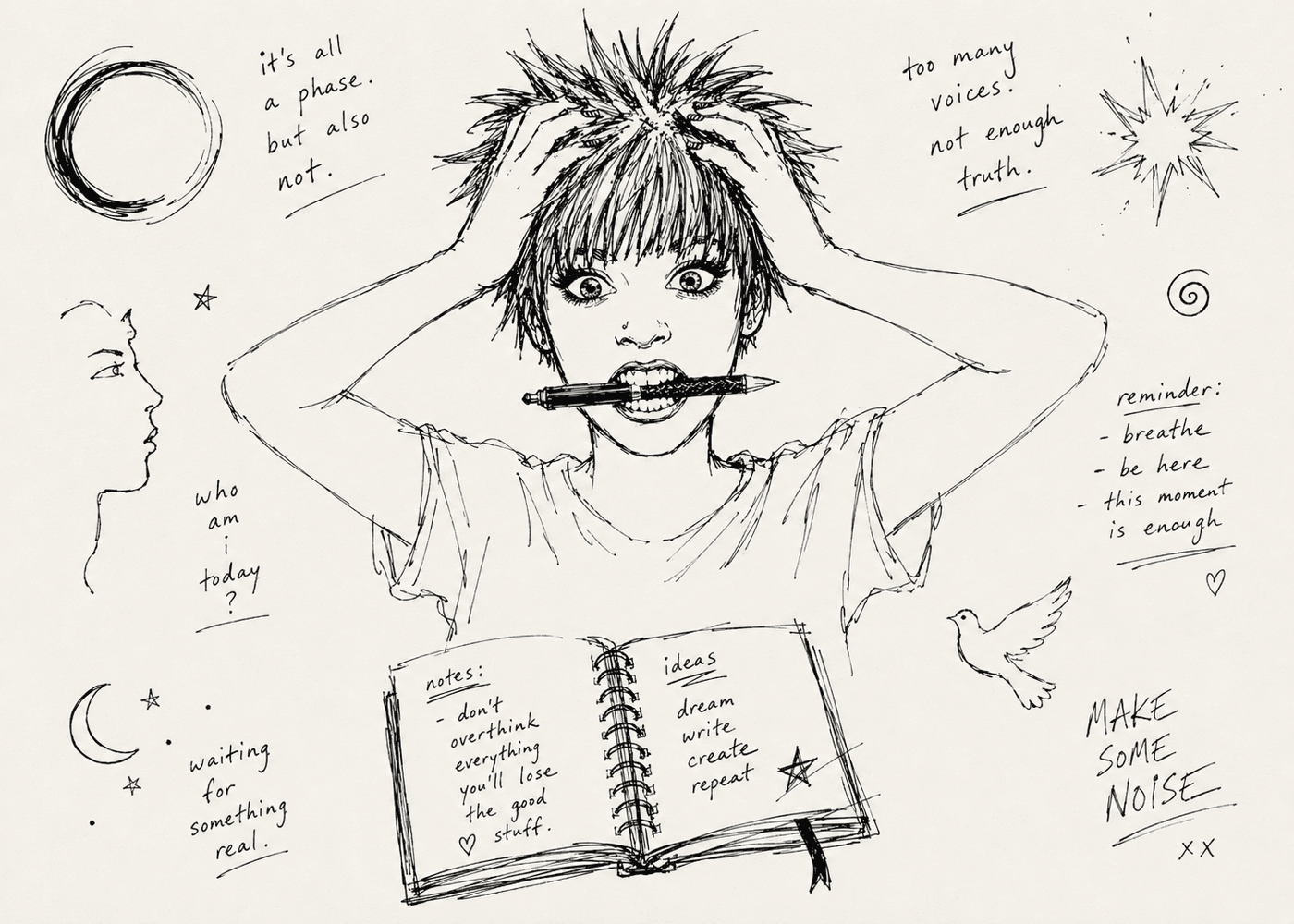
Here is the whole of it, and you can run it tonight with any notebook in the house. The first ten minutes are for emptying: write fast, write badly, let the noise out unedited, until the chatter thins and your own voice comes back through. Then look up and name where you actually stand today. Out of all of it, underline the one thing carrying the most weight — there is always one. Open it: what would it ask of you, if you let it? And before the cover closes, set one small move for tomorrow.
That’s the hour. Five turns, and you’re back in the conversation.
If the shape feels familiar, it’s the FOCUS Method — five movements you can return to on any page, for the rest of your life. We’ve laid it out in two parts: what trips most journaling up, and then the five movements themselves. Simple enough for an hour; deep enough that you never reach the bottom of it.
So why is it so easy to skip?
If it’s that simple, why doesn’t everyone do it? Because alone, you won’t. The hour you set aside is the first one you hand back the moment the week fills up. Resolve is a thin thread; it parts at the first good excuse.
What actually holds is older and humbler than willpower: a set time, and other people in the room. You show up because it’s on, because someone is keeping the hour, because you said you would — and that, strangely, is enough.
So we keep the hour for you
Once a month, online and free, we run a guided Focus Session — the method, walked through together, an hour to find your way back to yourself. Bring a pen; that’s the only requirement. We bring the prompts, the timer, and the company. (There’s no open exploration hour at the end — that’s our in-person Open Page in Munich. This is the focused hour alone, wherever in the world you happen to be.)
Prefer the movements ready to hand — prompts to find, orient, clarify, unfold and steer, with space to come back to? That’s the FOCUS Method workbook. Or come to a session and let us keep the hour for you.
It lives on the same calendar as everything else. Subscribe there, and the next date will find you.
Find the next Focus Session → Or learn more about the FOCUS Method →
An hour a month is a small thing to give a life. It may also be the thing that keeps it yours — that keeps you choosing your direction, instead of waking some grey morning surprised by where you’ve ended up. You already know what you want. You have only stopped listening. The page is where you begin again. See you on the page.