You have, at some point, given a friend advice so clear and kind that you almost wished you could take it yourself. Their trouble lay open in front of you, and the way through was plain. Then you went home to your own life, where nothing was plain at all, and the same good sense deserted you at the door. Psychologists call this Solomon’s Paradox: we are wise about everyone’s life but our own. The difference is not intelligence. It is distance. You read a friend’s country from above, whole. You are lost somewhere inside your own. A map of your own life is how you borrow the distance back.
The stranger at your own address
You know the feeling, even if you have never named it. You are standing at some ordinary crossroads — a job or career, a city, a person, a version of yourself — and you cannot say which way to go, though you have solved harder problems for other people all week. You do what a stranger does in an unfamiliar town: you ask directions. You survey your friends. You read one more article. The decision still sits there, untouched, because none of the borrowed maps are of your country.
This is what it costs to be a stranger at your own address, and the cost is not loud. It is a slow tax: choices made half-blind, the same wrong turning taken twice, whole years spent a little off from the life you meant to be living. You can be surrounded by people who love you and still feel unmet, because the one person who cannot see you clearly is you. It is a particular loneliness — a homesickness for a country you are already standing in.
The Germans keep a word for the feeling: unheimlich, literally ‘unhomely’ — the small dread of being a stranger in your own house. The novelist Albert Camus gave it a face in Meursault, the outsider of his most famous novel — a man so estranged from his own life that he watches it happen to him like weather. Most of us are gentler outsiders, but outsiders even so: present at our own lives without quite living in them, going through the rooms of a house we have somehow never moved into.
You are already the wise one
That advice you gave your friend hides a clue worth keeping, though. Your wisdom is not missing; you spent it on someone else an hour ago. It is only aimed the wrong way — outward, where you can see, rather than inward, where you cannot. The wise friend and the lost stranger are the same person. The single difference between them is where they are standing.
Two psychologists, Igor Grossmann and Ethan Kross, gave the paradox its name and then asked the question that matters: can you move yourself to the wise position on purpose? Grossmann studies wisdom; Kross studies the voice that never stops talking inside our heads. In their experiments, people who considered their own problem as though it belonged to someone else — or watched it from a few steps back, like a scene in a film — reasoned better on the spot: calmer, fairer, quicker to allow that things might change. Distance did it. The stranger’s-eye view, turned deliberately on your own life, is not a loss. It is the whole trick. It also means the most informed witness to your life is not some expert you have yet to find. It is you, seen from the right distance.
The catch is that you cannot command yourself to see your life from a distance any more than you can command yourself to sleep. Will alone will not lift you out of your own head. You need something to lift you: a device that takes the life out of you and sets it down where you can walk around it.
So draw it
Here is the device, and it is very old: a map — a life map, drawn by hand. It is not a timeline of milestones, not a chart of goals to prioritise, not a five-year plan; those organise a life, while this one only helps you see the one you are already living. Take a sheet of paper wider than a shopping list, and do not plan it — a life is drawn by discovering it, not by knowing it first. There is a real pleasure in the doing, the absorption that overtakes anyone who starts to draw a map: the room going still, the hand running out ahead of the plan, the small satisfaction of a coastline coming right. What you put down is yours to choose, but each kind of mark shows you something the others cannot.
You could begin with the territories: the few places you actually live in — a marriage, a piece of work, the town you keep meaning to leave. Draw them the size they truly take up in your days, and you see at a glance where your hours and your heart are really going, which is seldom where you would have said. You could add the passages between them — the roads and bridges and river-crossings — because a life is its movements as much as its places, and the crossing you keep avoiding maps you as plainly as the ones you take. You could mark the edges, the cliffs and borders you keep arriving at, because the edge of what you will let yourself do is the truest boundary you own. And you could name the regions as they surface, in the truest words you can find — the tender ones, the unkind ones, the frankly funny ones: the long marsh of the in-between years; the harbour I keep leaving; the Republic of Good Intentions, population one. A name is not decoration. It is you deciding, at last, what a place has meant — and there is a sly glee in landing one exactly right.
Maybe, as you reach for the pen, the old objections rise. I wouldn’t know what shape my life even is, or which metaphor could hold it. I cannot draw. A whole life is too big a country — I would only get lost in it. Fair, all of them. They are also the exact reasons we made The Map of You — a deck of forty cards, each carrying one feature of a landscape, a picture you are free to copy, and an invitation to find it in your own life. You need not know the shape of things, or draw well, or take on the whole country at once. You draw a single card, and it hands you one place to begin.
You draw the first card and turn it over: River. A blue watercourse braids down its face; beneath it, a question in small type: What keeps you alive? What quickens you? And what is downstream? You did not have to invent the metaphor — the card handed you a river, and all you do is find the one already running through your life. You copy it onto the middle of your page (the card shows you how a river can be drawn; no one is marking you on it) and start naming what feeds it: this work, that friendship, the old ambition. Then the question turns you downstream — where is all this water actually going? — and your own hand catches you out. The fast, bright water, the part that quickens you, is a side-stream; the main current, the bulk of your days, runs somewhere flat you never chose. The card never told you that. It handed you a river and three questions and let the drawing answer them. It is lighter out on the page, somehow, than it was circling in your chest — and it came from one card, one place, so the whole life never had to arrive at once.
That is what a card does, and what the drawing keeps doing: it lifts you out of the fog and sets you above your own country, the way a traveller stands on a hill and takes in a whole valley the residents only ever move through. For the length of it, you meet the stranger in yourself on purpose. The estrangement that felt like exile turns useful — it becomes the traveller’s distance, the shift in perspective that lets you see your own country and, seeing it, begin to inhabit it more deeply than the resident who never once looked up.
You cannot be lost and located at the same time.
There is a plain reason life mapping works, and none of it is mystical. A thought kept only in the head has to be carried, every part of it, all at once. Set it on the page and the page carries it instead; your eye can rest on the whole at last, instead of your mind straining to hold each piece in view. Jill Larkin and Herbert Simon — Simon a polymath who won a Nobel for studying how people actually make up their minds — once asked why a diagram can be worth ten thousand words, and found the answer plain: a picture gathers what belongs together into one place, so the eye does the searching the mind would otherwise do from memory alone. The map remembers, so you do not have to. The attention all that holding had been eating comes quietly back to you.
The one mark that changes the rest
When the page is full enough, make the mark everything has been waiting for. Somewhere on the map, press a dot, and beside it write two words: you are here.
It looks like nothing. It asks for everything. You cannot honestly set that dot down without deciding where, in all of this, you actually stand — what is behind you, what surrounds you, which way you are facing. Every real map carries this mark, and it is the one you could never place from inside the fog, because you did not know where you were. Now you do. That is clarity — not certainty about what comes next, only the plain knowledge of where you stand. You cannot be lost and located at the same time. The moment the dot goes down, you stop drifting through your life and start standing somewhere in it, on purpose — and standing somewhere is where every next step begins.
You do not need the deck to draw that dot — but if the blank page is where you stall, this is the way past it. Try The Map of You — free →
Leave the edges wild
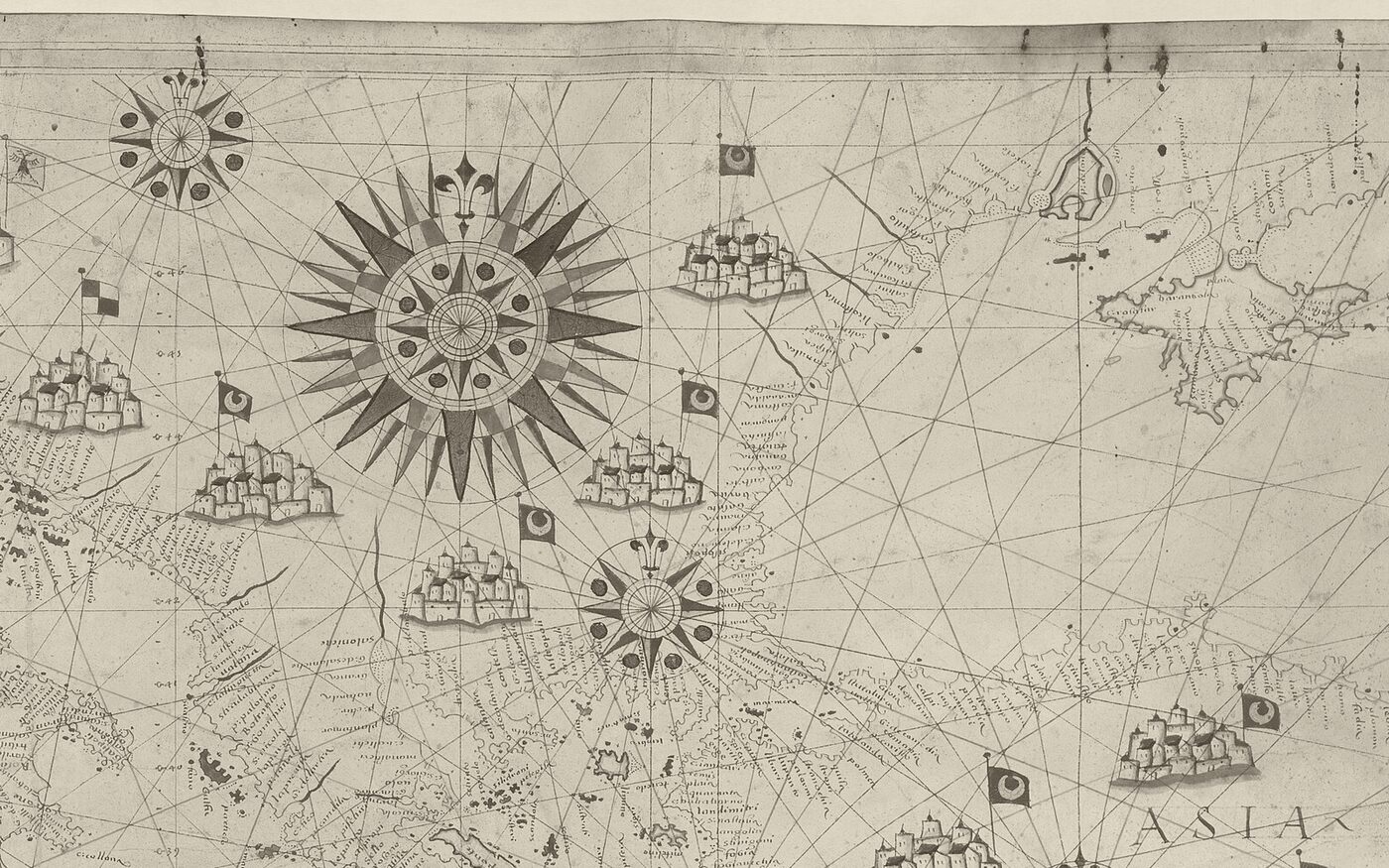
You do not have to fill the whole page. The old mapmakers, reaching the end of what they knew, wrote terra incognita across the blank and let it stand, sometimes with a sea monster drawn in for honesty. A life map is allowed the same. The unmapped quarter is a door left ajar — country you have not travelled yet, or have chosen, for now, to keep to yourself. You are allowed to begin before you understand everything. It is the only way anyone ever begins. What a place finally means can wait too: the deck’s field guide is there to read after you draw, never before, telling you what it has meant to others only once you have said what it means to you — so the map stays yours.
Then walk back in
None of this predicts anything, and one caution keeps the whole practice honest. A map is always a simplification: it leaves things out, flattens what is round, holds still for a moment what never stops moving. Alfred Korzybski, the Polish-American thinker who spent a lifetime on the gap between our words and the world they point at, fixed this in a sentence that has outlived him — the map is not the territory. Confuse the two and the map becomes a cage: a verdict you feel bound to live inside. Keep the difference and it becomes what it was always for — a way of finding your bearings, not a sentence passed on where you must stay. That is the mercy of a life map: it decides nothing. It hands you your bearings, and then it hands back your life, because a map is made to be folded up and carried home. When the country changes, as it will, because you will, you simply draw it again.
This is the turn the whole practice is built on. The stranger at your own address and the wise friend who saw everything clearly were never two people. They were you, at two distances — and a map is how you borrow the far one on purpose: climb high enough to see your country whole, then carry that sight back down into your days. None of it, though, happens in the reading. You do not come home by understanding that you could; you come home by drawing the map. The page, meanwhile, is still blank — the last distance between you and the country you have been missing.
Draw a card, then your own version of that place, in your own hand — tonight, with nothing but a pen and a page. The deck, its app, and its field guide are free.
The stranger you have been at your own address has waited long enough. One card, one pen, one evening — and you can finally let them come home.
Draw the country you have been living in without quite seeing. Place the dot. See you on the page.
The research behind this
The claims here rest on:
- Solomon’s Paradox and self-distanced reasoning: Igor Grossmann & Ethan Kross, “Exploring Solomon’s Paradox: Self-Distancing Eliminates the Self-Other Asymmetry in Wise Reasoning,” Psychological Science (2014); Ozlem Ayduk & Ethan Kross, “From a Distance: Implications of Spontaneous Self-Distancing for Adaptive Self-Reflection,” Journal of Personality and Social Psychology (2010).
- Why putting thought on paper eases the mind: Jill H. Larkin & Herbert A. Simon, “Why a Diagram is (Sometimes) Worth Ten Thousand Words,” Cognitive Science (1987); on cognitive offloading, Evan F. Risko & Sam J. Gilbert, “Cognitive Offloading,” Trends in Cognitive Sciences (2016).
- Honest limits: Paul Farrand, Fearnley Hussain & Enid Hennessy, “The Efficacy of the Mind Map Study Technique,” Medical Education (2002) — benefits real but modest; Girija Kaimal, Kendra Ray & Juan Muniz, “Reduction of Cortisol Levels and Participants’ Responses Following Art Making,” Art Therapy (2016) — lowered stress in people with no art training. Life mapping as a documented therapeutic and social-work method appears in the practitioner literature and in clinical case studies.
- “The map is not the territory”: Alfred Korzybski, Science and Sanity (1933).